10-15-Year Planning Window
Treat year 10 as the point to start planning a complete-system replacement, not necessarily the day every component must be removed.
Phoenix Fire Alarm Systems explains why most complete systems enter a replacement-planning window after 10 to 15 years, even though individual components age on different schedules. In Phoenix, extreme heat, dust, and monsoon humidity can narrow the safe margin for equipment in attics, rooftop units, and unconditioned mechanical rooms.
Treat year 10 as the point to start planning a complete-system replacement, not necessarily the day every component must be removed.
Smoke detectors, CO sensors, panels, wiring, and notification devices have different service lives, so the manufacture date and condition of each component matter.
Documented inspection and functional testing reveal sensitivity failures, panel faults, and notification problems early enough to phase the work.
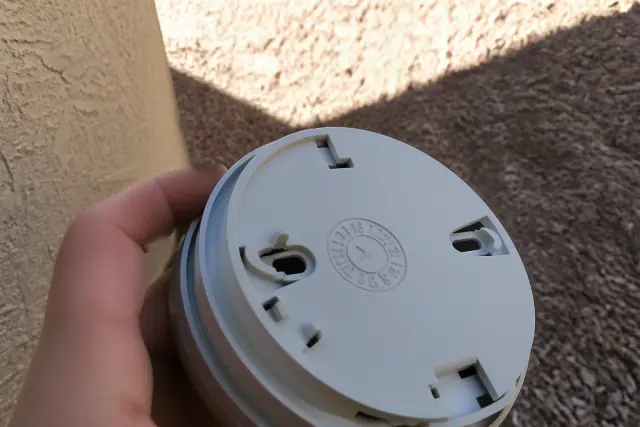
The date stamped on the detector housing. The 10-year interval starts at manufacture, not purchase or installation.
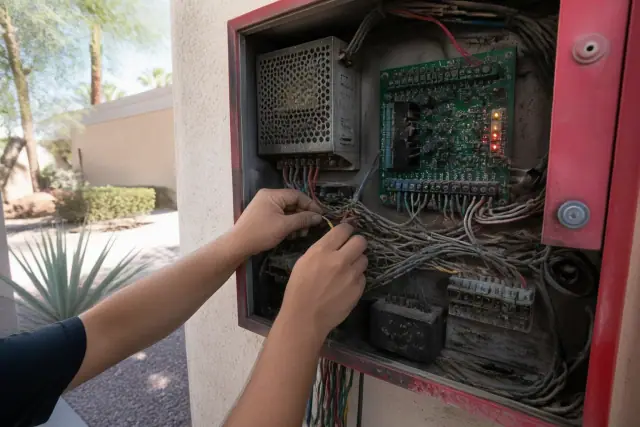
Persistent trouble lights or ground-fault indicators on an older control panel. Recurring faults across several zones can point beyond a single failed device.
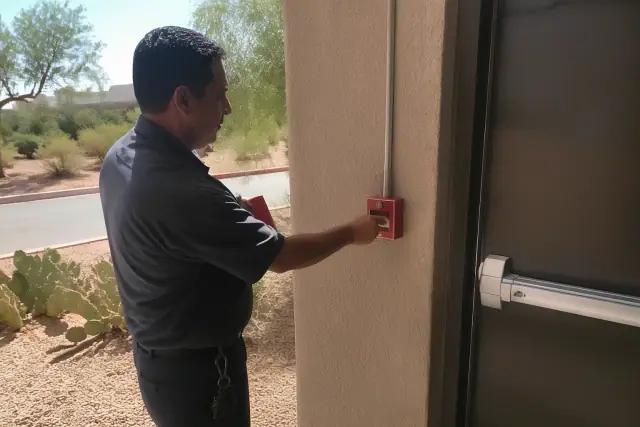
A technician functionally testing initiating devices, notification appliances, and the monitoring connection. The resulting record supports a phased replacement plan.
Smoke detectors carry a 10-year rated life, while CO sensors typically last around 7 years. Combination units follow whichever interval comes first.
Panels and wiring can remain serviceable longer than sensors, but heat-cycled insulation, corroded contacts, obsolete firmware, and unavailable parts can end that life early.
Frequent false alarms, delayed activation, failed sensitivity tests, or repeated panel faults are reasons to evaluate replacement before a complete outage.
Replace batteries at least once a year; many technicians recommend every 6 months. A fresh battery may stop chirping, but it does not reset a detector's 7- or 10-year service life.
| Component | Typical Replacement Point | Planning Note |
|---|---|---|
| Smoke alarms and detectors | 10 years from manufacture | Replace by the date stamped on the device. |
| Carbon monoxide detectors | Around 7 years | The electrochemical sensor has a shorter service life. |
| Combination smoke/CO units | Whichever interval comes first, often 7 years | Follow the manufacturer's date and recommendation. |
| Panels, wiring, pull stations, and notification devices | Often serviceable to 15 years | Condition, testing history, parts support, and maintenance determine timing. |
| Complete fire alarm system | Plan around 10 to 15 years | Stage replacement when devices age before the panel. |
A system reaches practical end of life when repair parts disappear, firmware support ends, or a component repair approaches roughly half the cost of comparable new equipment. Rigorous annual testing can sometimes stretch panel life toward 15-20 years, but it does not extend the shorter replacement intervals for smoke and CO sensors. Older conventional systems also identify a faulty zone rather than the exact device, while an addressable upgrade can reduce diagnostic time. Replacement is often phased: aging detectors first, then the panel, wiring, notification appliances, or voice evacuation equipment as condition and code requirements dictate.
Phoenix summer attic temperatures regularly exceed 140°F, and repeated heat cycling can fatigue wiring insulation and connector housings. Dust can cause sensor drift, while monsoon humidity swings encourage corrosion in rooftop equipment and unconditioned mechanical rooms. Building use matters too: commercial occupancies require documented annual testing at minimum, with some systems tested semiannually or quarterly, and current audibility, intelligibility, strobe, and monitoring requirements can affect whether old equipment remains suitable. Homes built before the mid-2010s may still have original hardwired devices that are already near or beyond the 10-year mark.
Should a 20-year-old smoke detector be replaced? Yes; it is twice past its 10-year rated life, so devices dating from the late 1990s or early 2000s should be treated as a replacement priority. How much can replacement cost? A residential project may range from a few hundred to a few thousand dollars, a small commercial system often starts in the low thousands, and a large facility or multi-building campus can reach six figures. For comparison, small-building inspection and testing typically runs $300 to $1,000 per year, monitoring commonly costs $50 to $60 per month or $200 to $800 annually depending on the plan, and board repair is generally around $350 for the first hour and roughly $100 per hour after that, including parts and labor. An on-site evaluation is still needed to compare a panel-only upgrade, phased work, and full replacement for the actual device count and building conditions.
Gather the manufacture dates, recent test reports, recurring panel faults, and information about available replacement parts. An inspection can separate devices that must be replaced now from panel, wiring, or notification work that can be planned in phases.