Proudly serving Phoenix, Mesa, Glendale, Scottsdale, Tempe, Chandler & surrounding areasCall or Text 24/7: 602-449-8143
Aerial view of residential neighborhoods, desert washes, and low-rise buildings in Phoenix, AZ.

Voice Evacuation & Mass Notification Systems: Speaker Integration & Design in Phoenix, AZ

Phoenix Fire Alarm Systems designs, installs, and services voice evacuation and mass notification systems for commercial properties in Phoenix, Arizona. We integrate speaker circuits, strobes, and digital voice command centers with addressable fire alarm platforms. Our work also covers fire alarm system design, installation, inspection and testing, monitoring, repair, maintenance, upgrades, and panel service. The result is one networked system for detection, paging, and occupant notification.

Spoken instructions matter in Phoenix high-rises, hospitals, schools, hotels, warehouses, and assembly spaces where a tone alone cannot direct phased evacuation. We hold current Arizona Registrar of Contractors licensing and have NICET-certified technicians on staff who design to NFPA 72 requirements. Each project includes a documented site survey, intelligibility mapping, and commissioning test tailored to occupancy, ceiling height, and ambient noise. We also understand the plan-review details Phoenix Fire Department inspectors expect before final sign-off.

From a 1960s downtown office-tower retrofit to a new south Phoenix distribution center, system design is based on how occupants must move and how messages will sound in the actual space.

Phoenix Fire Alarm Systems installs and services voice evacuation and mass notification systems in Phoenix and the surrounding metro, including Scottsdale, Tempe, Mesa, Chandler, and Glendale.

★ ★ ★ ★ ★4.9/5 Average Rating · 20+ Years of Experience · Thousands of Customers Helped · Licensed & Insured · Residential & Commercial

Voice Evacuation & Mass Notification Benefits

What Are Voice Evacuation and Mass Notification Systems?

A voice evacuation system supplements or replaces standard alarm tones with spoken instructions delivered through dedicated building speakers. Pre-recorded messages can activate automatically, while a live paging microphone lets fire wardens or responders direct occupants as conditions change.

A mass notification system expands that communication beyond fire to severe weather, security incidents, chemical releases, facility lockdowns, and other emergencies. It can distribute live or pre-recorded messages through speakers, strobes, digital signage, and mobile alerts.

Both can integrate with the fire alarm control panel and operate on a shared addressable backbone. Zoned programming allows affected floors, rooms, or buildings to receive the instructions appropriate to their part of the emergency.

Benefits of Coordinated Emergency Communication

A coordinated notification design helps occupants receive clear, accessible directions instead of a generic tone with no context. The system can support routine fire response as well as broader facility emergency plans.

  • Spoken instructions for the emergency and affected zone
  • Automatic pre-recorded messages with live voice override
  • Phased evacuation logic for multi-story buildings
  • Multi-hazard alerts for weather, security, and facility events
  • Speakers, strobes, digital signage, and mobile alert integration
  • Accessible audible and visual occupant notification
  • One command point for coordinated multi-building communication
  • Shared detection, monitoring, paging, and notification infrastructure
Emergency Communication Services

Voice Evacuation & Mass Notification Services

We plan each system around the building's occupancy, construction, ceiling heights, ambient noise, and emergency-response needs. Design, installation, integration, testing, and ongoing service stay coordinated from the first survey through final acceptance documentation.

Voice Evacuation System Design

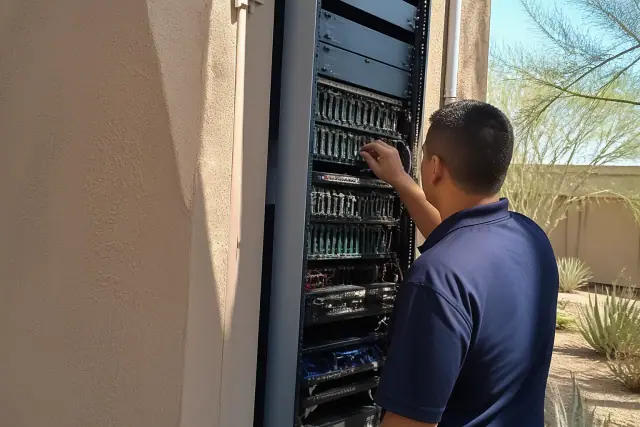
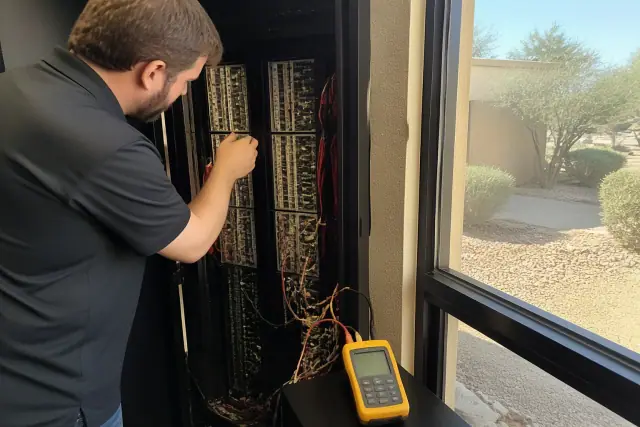
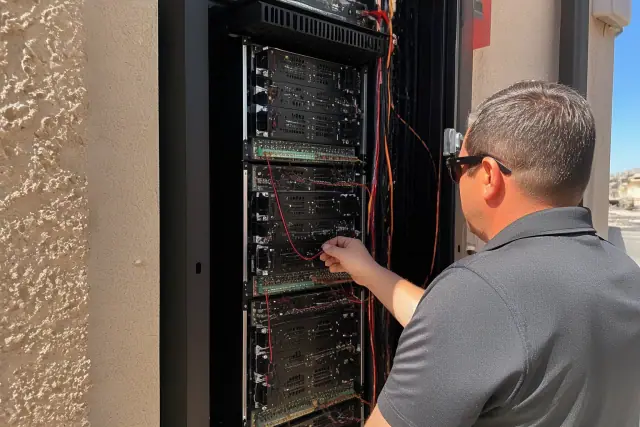
Technician inspecting modular amplifier cards in a voice evacuation system rack at a worksite in Phoenix, AZ.

We design message content, speaker zones, and phased evacuation logic for office towers, hospitals, schools, hotels, and other assembly occupancies. Each plan reflects how people should move during an emergency rather than applying one alarm sequence to every floor.

Request Estimate

Mass Notification System Integration

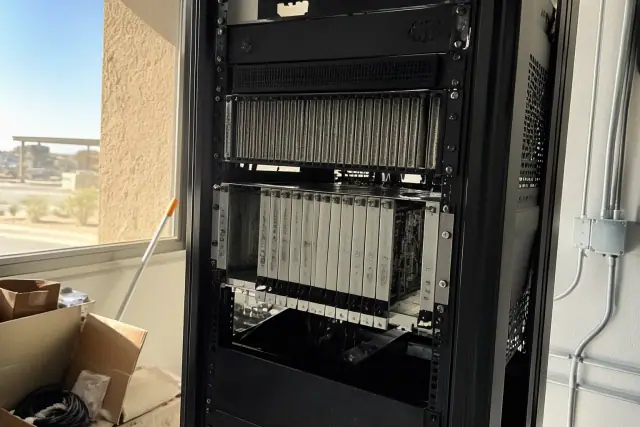
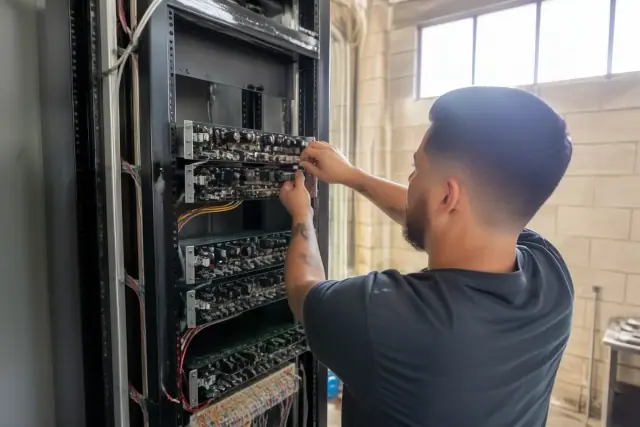
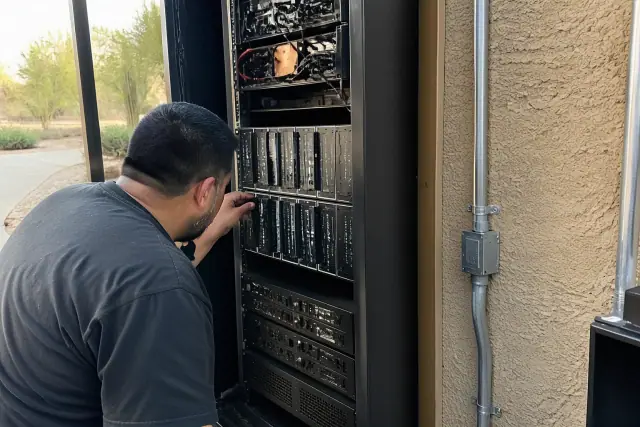
Technician inspecting modular amplifier cards in a voice evacuation server rack at a jobsite in Phoenix, AZ.

Mass notification extends the system to weather, security, chemical, and facility-wide events. We integrate those functions with the existing fire alarm control panel and facility paging infrastructure instead of creating a separate, uncoordinated network.

Request Estimate

Speaker and Strobe Installation

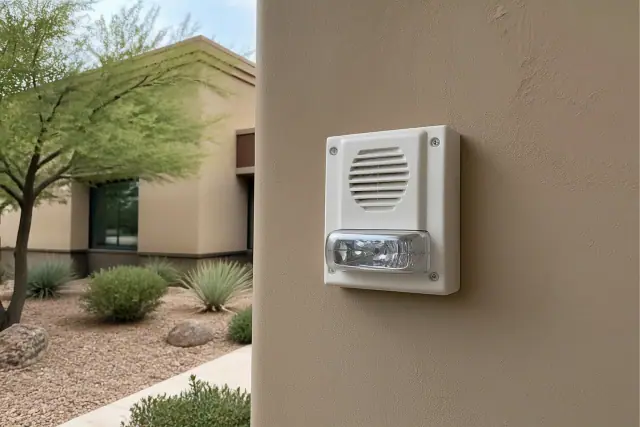
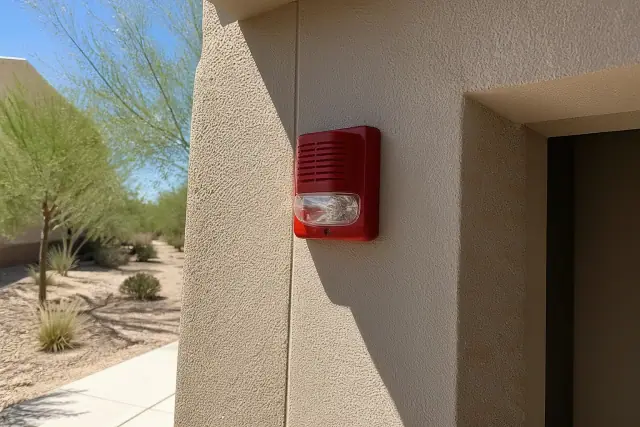
Wall-mounted horn-strobe emergency notification device installed on a stucco building in Phoenix, AZ.

Speaker placement follows NFPA 72 spacing guidance for ceiling height and room use, with every notification zone mapped individually. ADA-compliant designs coordinate audible notification with visual strobes rated at 15, 75, or 110 candela according to room size.

Request Estimate

Fire Alarm Panels and Voice Command Centers

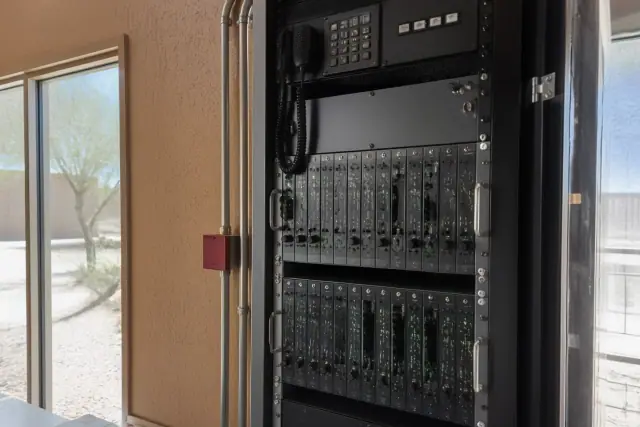
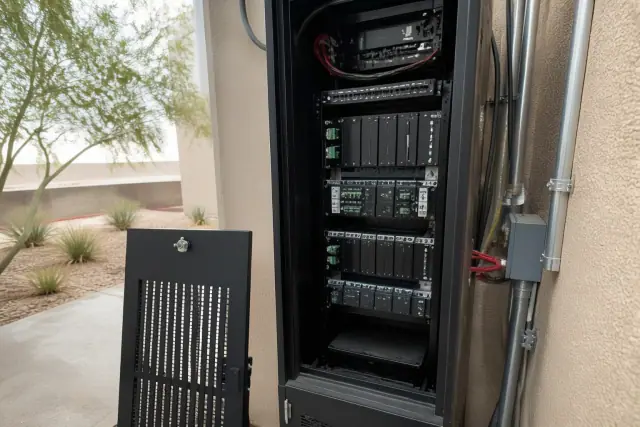
Technician inspecting fire alarm panels and voice evacuation systems inside a server rack in Phoenix, AZ.

Panel installation can include voice command centers, digital alarm communicator transmitters, and network cards for connected campuses. Programming coordinates detection, speaker circuits, strobes, live paging, and monitoring on the same fire alarm platform.

Request Estimate

Intelligibility Testing and Commissioning

Technician testing a voice evacuation server rack in Phoenix, AZ.

Commissioning includes STI/CIS intelligibility measurements as well as sound-pressure checks. We test every speaker, strobe, and initiating device, then prepare the acceptance documentation needed for Phoenix Fire Department final inspection.

Request Estimate

Inspection, Monitoring, and Maintenance

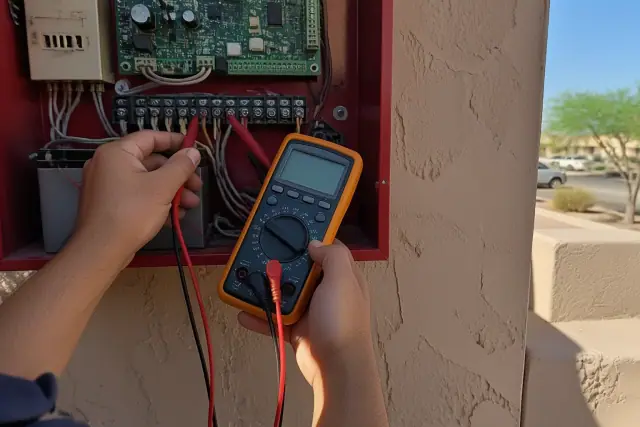
Technician using a multimeter to test a fire alarm system terminal block during maintenance in Phoenix, AZ.

Ongoing service covers scheduled inspection and testing, repair and troubleshooting, and 24/7 central-station monitoring. Cloud-based monitoring options can also give facility managers real-time system status from a phone or laptop.

Request Estimate
Fire Alarm Platform Options

Types of Commercial Fire Alarm Systems

Commercial properties generally use conventional, addressable, wireless, hybrid, or voice evacuation and mass notification configurations. The right platform depends on building size, occupancy, existing infrastructure, and whether the work is a new installation or phased retrofit.

Wall-mounted fire alarm horn-strobe device installed on a stucco wall at a job site in Phoenix, AZ.

Conventional Fire Alarm Systems

Conventional systems organize detection by circuit rather than identifying each individual device at the panel. They are typically used for smaller occupancies and can remain part of a hybrid configuration during a phased upgrade.

  • Detection grouped by circuit zone
  • Suited to smaller building layouts
  • Compatible with standard notification appliances
  • Can remain during phased modernization
  • Selected according to occupancy and building size
Request Estimate
Technician inspecting a voice evacuation amplifier rack for a fire alarm system in a Phoenix, AZ warehouse.

Addressable Fire Alarm Systems

Addressable systems identify the exact device location at the control panel and are the common foundation for large Phoenix commercial buildings. The network can coordinate detection, speaker circuits, strobes, voice commands, and monitoring across multiple zones.

  • Individual device identification
  • Zoned notification and phased evacuation logic
  • Shared backbone for detection and voice
  • Network support for multi-building campuses
  • Remote diagnostics through connected system features
Request Estimate
Technician inspecting a voice evacuation amplifier rack at a job site in Phoenix, AZ.

Wireless Fire Alarm Systems

Wireless equipment can solve access problems in older buildings where running new conduit is impractical. We evaluate existing construction, device locations, and integration needs before recommending it for a retrofit.

  • Useful where new conduit access is limited
  • Evaluated for older-building retrofit conditions
  • Planned around existing construction
  • Integrated with the selected fire alarm platform
  • Matched to building and occupancy needs
Request Estimate
Technician inspecting modular amplifier cards in a voice evacuation rack at a jobsite in Phoenix, AZ.

Hybrid Fire Alarm Systems

Hybrid configurations combine addressable and conventional technologies during phased upgrades. This approach can help organize replacement around building operating hours while maintaining partial monitoring during the transition where possible.

  • Addressable and conventional technology combined
  • Supports phased system upgrades
  • Can be scheduled around operating hours
  • Allows coordinated panel and device migration
  • Planned for the building's transition needs
Request Estimate
Technician inspecting voice evacuation and mass notification system wiring in a Phoenix, AZ server rack.

Voice Evacuation and Mass Notification Systems

Voice evacuation adds spoken fire instructions, while mass notification adds live or pre-recorded multi-hazard communication. NFPA 72 governs both notification functions, and UFC 4-021-01 also applies to federal and Department of Defense sites.

  • Pre-recorded fire evacuation instructions
  • Live paging override for changing conditions
  • Fire, weather, security, and facility alerts
  • Zoned instructions for affected areas
  • Integration with speakers, strobes, signage, and mobile alerts
Request Estimate
Finding Your Right Fit

Choosing the Right Notification Approach

The right design starts with occupancy load, construction type, building use, ambient sound, and the emergencies the facility must communicate. A hospital, hotel, school, high-rise, retail space, and industrial campus each require different messaging, zoning, coverage, and system integration decisions.

Arizona-Licensed, NICET-Supported Design

Phoenix Fire Alarm Systems holds current Arizona Registrar of Contractors licensing and has NICET-certified technicians on staff. Designs are developed to NFPA 72 requirements and coordinated with the adopted building and fire codes that apply to the property.

Phoenix Plan Review Experience

The City of Phoenix enforces its adopted International Building Code and International Fire Code through the Phoenix Fire Department Fire Prevention Division. We handle permit submission and inspection scheduling as part of commercial fire alarm projects and prepare the acceptance records inspectors require.

Measured Intelligibility Commissioning

A loud signal is not automatically an understandable message. We map zones and use STI/CIS measurements during commissioning to evaluate speech clarity around reverberation, ceiling height, HVAC noise, and other real conditions in the building.

What Sets Us Apart

Why Choose Us for Emergency Notification Systems?

Our process connects the survey, design, permit drawings, installation, programming, commissioning, and final documentation instead of treating them as separate tasks. That continuity helps ensure the system is designed for the property, clearly heard in the field, and ready for inspection.

Request a Site Survey

Unintelligible Voice Messages

Parking-structure reverberation, warehouse ceiling height, and office HVAC noise can distort speech even when measured volume is high enough. A 20-story building especially needs understandable, floor-specific instructions for phased evacuation.

Uneven Audio Coverage

A blanket speaker count can leave coverage gaps or create excessive overlap. Speaker placement must account for ceiling height, room use, sound conditions, and the boundaries of each individual notification zone.

Single-Tone Evacuation Gaps

A horn or bell can signal danger but cannot explain whether occupants should exit, relocate, or shelter in place. High-rise, healthcare, hotel, and assembly settings often need pre-recorded instructions with live override for changing conditions.

Disconnected Notification Systems

Separate detection, voice evacuation, and mass notification products can complicate command and messaging. Integrated design coordinates all three functions on one life safety platform with shared zones, monitoring, and control logic.

Aging or Limited Panels

Panels older than 15-20 years, conventional systems installed before addressable technology became standard, and properties changing occupancy are common upgrade triggers. A phased replacement can blend old and new technologies while partial monitoring remains active where possible.

Heat, Dust, and False Alarms

Extreme summer heat and Salt River Valley dust intrusion contribute to device failures and false alarms in Phoenix systems. Troubleshooting includes checks of detector sensitivity and gasket seals as part of identifying the cause.

How It Works

Our Voice Evacuation System Process

The work progresses from field assessment and engineered drawings through installation, programming, testing, and acceptance documentation. Each phase stays connected to the building's occupancy, emergency plan, notification zones, and inspection requirements.

01.

Site Survey and Risk Assessment

We walk the building to document occupancy, construction, use, ceiling heights, HVAC placement, ambient noise, and existing fire alarm infrastructure. The survey also identifies access constraints and the emergencies the notification plan must address.

02.

Notification and Intelligibility Mapping

We plan speaker and strobe coverage by room and zone, accounting for ceiling height, reverberation, background sound, and phased-evacuation needs. Message content and live paging functions are matched to the way occupants must respond.

03.

System Design and Permit Drawings

The design defines the fire alarm platform, circuits, notification appliances, zones, control functions, and system interfaces. We prepare permit drawings and coordinate the submission for Phoenix Fire Department plan review.

04.

Wiring and Device Installation

Installation moves through rough-in wiring, speaker and strobe mounting, panel work, and connection of initiating devices. Retrofit access and operating schedules are considered when sequencing the field work.

05.

Panel Programming and Integration

We program voice command centers, message sequences, notification zones, live override, and monitoring interfaces. Detection, paging, strobes, digital signage, mobile alerts, and campus network functions are coordinated where the project includes them.

06.

Testing, Commissioning, and Acceptance

Before occupancy, we test every speaker, strobe, and initiating device and record STI/CIS intelligibility results. The completed acceptance documentation supports final inspection and sign-off by the Phoenix Fire Department.

Plan Clearer Emergency Communication

Schedule a Voice Evacuation System
Consultation

Call before your next permit submission to review the building, existing panel, notification goals, and likely project scope. We can help plan a new voice evacuation or mass notification system, an integrated upgrade, or service for current equipment.

Emergency Communication Help

Voice Evacuation & Mass Notification FAQs

These answers cover system functions, code thresholds, intelligibility, integration, costs, testing, and upgrade planning for Phoenix commercial properties.

Call Our Experts

A voice evacuation system is a fire alarm subsystem that delivers spoken emergency instructions through building speakers instead of, or in addition to, standard tones. It can use automatic pre-recorded messages and provide a live override for fire wardens or responding crews.

A mass notification system communicates emergencies beyond fire, including severe weather, chemical releases, security incidents, and facility lockdowns. It can use speakers, strobes, digital signage, and mobile alerts to deliver live or pre-recorded instructions.

Voice evacuation is primarily triggered by a fire alarm and delivers fire-related instructions. Mass notification supports fire plus weather, security, chemical, and other facility-wide events, often through a broader mix of communication channels. Both functions can share the same fire alarm platform.

An automatic detection device or manual control point activates the system, which routes the selected message through the programmed channels. Zoning lets affected areas receive one instruction while other areas receive different guidance, and networked campuses can coordinate several buildings from one command point.

The five common commercial configurations are conventional, addressable, wireless, hybrid, and voice evacuation or mass notification systems. Selection depends on building size, occupancy, existing construction, and whether the project is a new installation or retrofit.

NFPA 101 generally calls for voice evacuation in high-rises over 75 feet, assembly occupancies over 1,000 people, and healthcare facilities. Phoenix requirements also depend on adopted International Building Code and International Fire Code provisions and local amendments reviewed by the Phoenix Fire Department.

NFPA 72 requires audible signals to be at least 15 decibels above the average ambient level or 5 decibels above the maximum sound level lasting 60 seconds, whichever is louder. Sleeping areas have a separate minimum, and voice systems must also meet intelligibility requirements rather than volume alone.

Commissioning uses STI/CIS measurements to evaluate whether spoken messages remain understandable in the actual space. Testing considers reverberation, HVAC noise, room use, ceiling height, and individual notification zones in addition to sound-pressure levels.

Most Phoenix commercial systems use both. Pre-recorded messages provide an automatic, consistent response, while live voice override lets authorized personnel give updated instructions during a drill or actual emergency.

Yes, when the existing infrastructure and project design support it. Integration can keep detection, monitoring, paging, strobes, and emergency messaging on one addressable backbone instead of operating a separate parallel system.

Commercial fire alarm installations in Phoenix typically run from $15,000 to $200,000 depending on square footage and system complexity. Voice evacuation speakers and strobes range roughly from $50 to $500 per device, while dedicated voice evacuation control panels run from $2,600 to $3,500 before installation labor.

NFPA 72 requires fire alarm system testing at least annually. Sprinkler-monitoring devices and batteries may require more frequent inspection, so the service calendar should match the occupancy type and local fire marshal inspection cycle.

Stop what you are doing, leave belongings unless they are within immediate reach, and use the nearest marked exit rather than an elevator. Follow voice instructions because they may direct occupants to a particular stairwell or tell them to shelter during phased evacuation, and do not re-enter until Phoenix Fire Department or building management gives the all-clear.