Read the Panel First
Pull the event history, identify whether the signal is a trouble, supervisory, or alarm condition, and record the zone or device address before resetting anything.
Phoenix Fire Alarm Systems recommends starting at the fire alarm control panel, recording the exact fault code, zone, and device address, and then checking power, supervised wiring, and the indicated device in that order. This method matters because repeated resets can hide an underlying wiring or sensor defect, while Phoenix heat, desert dust, and monsoon humidity can create recurring nuisance faults. The same sequence applies across office towers, Loop 202 warehouses, and multi-family properties from Arcadia to Desert Ridge.
Pull the event history, identify whether the signal is a trouble, supervisory, or alarm condition, and record the zone or device address before resetting anything.
Check incoming line voltage, transformer output, and standby battery voltage under load, then verify continuity and ground isolation along the affected circuit.
A ground fault, open circuit, panel lockup, or signal that returns after reset needs a licensed technician; if the system remains impaired, keep a documented fire watch until it is restored.
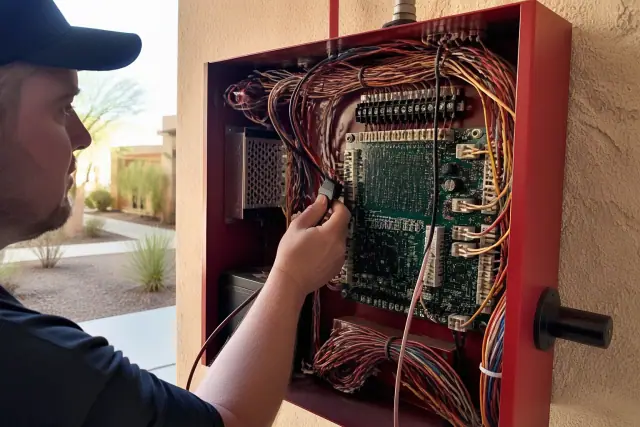
The display with the exact fault code, timestamp, zone, and device address. The first recorded event often identifies where an intermittent failure began.
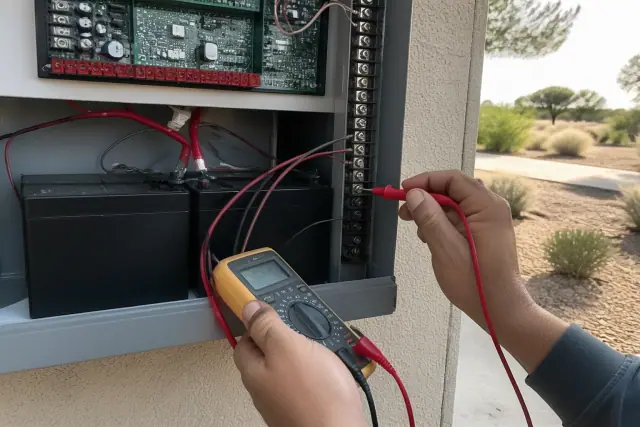
A meter checking standby batteries under load and a supervised circuit end to end. This separates a weak power source from an open, shorted, or grounded conductor.
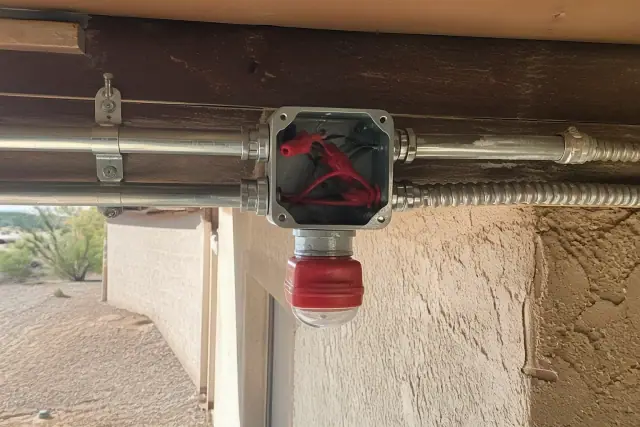
Dust inside a detector chamber alongside chafed insulation, loose terminals, and moisture in conduit. These conditions help distinguish sensor contamination from a wiring fault.
Read the FACP display and event history before silencing or resetting the system; capture the signal type, fault code, zone, and device address.
The diagnosis changes with the signal type, whether the same address repeats, measured battery and circuit values, detector age, and nearby dust, steam, insects, humidity, or electrical noise.
Arrange technician diagnostics when a ground fault, open circuit, blank panel, failed reset, or repeated nuisance alarm persists; begin a documented fire watch if the impairment cannot be cleared.
Do not repeatedly reset or silence the panel without documenting the initiating event, and do not replace a device until upstream power and wiring have been tested.
| Panel Indication | Likely Direction | Diagnostic Action |
|---|---|---|
| Steady trouble tone or yellow LED | Supervisory, power, wiring, or device fault | Record the fault code, zone, and device address before resetting. |
| Chirp every 30 to 60 seconds | Low battery or trouble on a specific zone | Read the panel display and load-test the standby batteries. |
| Repeated alarm from one address | Detector contamination, sensitivity drift, or a local environmental trigger | Inspect the chamber and test the detector against its listed sensitivity range. |
| Infinite or near-zero end-of-line reading | Open circuit or short circuit | Segment the affected loop and test continuity and ground isolation. |
| System cannot be restored | Detection or notification remains impaired | Arrange a documented fire watch until repairs are complete. |
A steady trouble tone, yellow trouble LED, or intermittent chirp differs from the continuous signal used for an alarm, but it still indicates a condition that needs attention. A chirp every 30 to 60 seconds commonly points to a low battery or a trouble condition on a specific zone. Ground faults, open circuits, and low-voltage battery conditions are frequent causes, while a repeated alarm from the same address can indicate a contaminated or drifting detector.
Phoenix summer highs above 110°F increase HVAC dust loading, and July and August monsoon humidity can contribute to nuisance activations; steam, insects, and nearby electrical noise can produce similar symptoms. Standby batteries have a service life of roughly four to five years, while smoke detectors past ten years old are often replaced when sensitivity testing or bench testing confirms a fault. Systems more than fifteen years old tend to develop recurring component faults, and systems installed more than twenty years ago can be stronger replacement candidates when parts are no longer supported. In older commercial buildings, chafed insulation, rodent damage, loose terminals, and moisture intrusion in conduit can shift the diagnosis from a device problem to a circuit problem.
How often should a fire alarm system be tested? NFPA 72 calls for annual testing of initiating devices and notification appliances, quarterly battery checks, and smoke-detector sensitivity testing at intervals tied to manufacturer listings. What happens after a failed inspection? Correct the documented deficiencies, retest the system, and maintain a fire watch when an impairment affects detection or notification coverage. What can maintenance or repair cost? Commercial maintenance contracts typically run $200 to $800, standalone inspections for smaller commercial buildings run $300 to $1,000 per year, and repairs can range from a few hundred dollars for one detector or wiring repair into the thousands for a panel board or multi-zone fault. When does replacement enter the discussion? Commercial replacement generally runs $0.50 to $1.00 per square foot, with total projects ranging from roughly $25,000 to well over $100,000 depending on building size, device count, and voice evacuation or mass notification needs; professional monitoring typically runs $25 to $100 per month depending on system complexity and communication method.
Share the exact panel message, zone or device address, property type, and whether the condition is a trouble, supervisory, or alarm signal. A technician can use those details to plan the right diagnostic checks and provide a written estimate after the fault is identified.